Heat moves fast, and in industrial systems, every degree counts. You don’t want hot spots, wasted energy, or equipment struggling to keep up. That’s where smart heat management comes in.
If you’ve ever wondered how does a plate heat exchanger work, it’s simpler than it looks: thin metal plates, fluids moving opposite each other, and heat transferring efficiently without the two mixing. It’s clever, compact, and seriously effective.
And yes, price matters too. Knowing the Plate Heat Exchanger price before you invest can save headaches, help plan budgets, and keep your operation running smoothly.
The Plate Heat Exchanger Working Principle
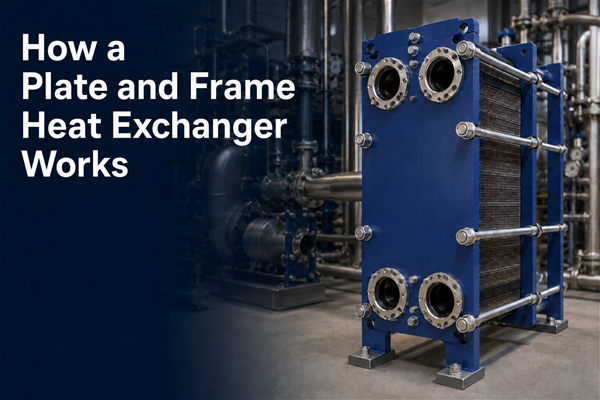
The Plate heat exchanger working principle is all about moving heat fast without mixing fluids. Picture a stack of thin metal plates jammed into a frame. Each plate has bumps and grooves. Those bumps make the fluid swirl and crash against the metal. That turbulence? That’s what makes heat transfer so efficient.
Hot fluid runs through alternating channels. Cold fluid slips through the channels beside it. Heat jumps straight through the metal from hot to cold. The fluids never touch. No mess, no cross-contamination. Just raw energy moving where it needs to go.
Most systems run counterflow. That means the fluids move in opposite directions. It keeps the temperature difference alive across every plate, squeezing every bit of heat possible out of a compact package. Small size, huge payoff. Engineers love these because they give more performance in less space than bulky shell-and-tube units.
Why Plate and Frame Designs Work So Efficiently
A plate and frame heat exchanger uses thin plates to maximize heat transfer area while keeping fluid volume low. That matters because thinner surfaces allow heat to pass faster, while narrow channels keep the fluid close to the transfer surface.
The corrugation inside each plate also helps by forcing fluid into a more active path instead of allowing it to move in a straight, slow line. That movement improves thermal exchange and helps prevent stagnant zones where performance would drop.
Another reason these systems stay popular is flexibility. In many cases, additional plates can be added later if thermal demand increases. Instead of replacing the full exchanger, operators can expand capacity by modifying the plate pack.
That makes these units practical for systems expected to grow over time.
What Happens Inside During Operation
To really understand how does a plate heat exchanger works, it helps to picture the fluid path inside the frame.
The first fluid enters through one port and spreads through every other plate channel. The second fluid enters through a different port and fills the remaining channels.
As both fluids move through the exchanger, heat continuously transfers through each plate surface. Because the channels are narrow, there is strong contact between the fluid and the metal surface at nearly every point.
This creates high transfer efficiency even when the unit itself does not occupy much floor space.
That is why many industrial buyers choose plate systems when selecting modern heat transfer products for compact thermal control.
What Are the Type of Plate Heat Exchanger Types
Not every process runs under the same temperature, pressure, or fluid condition, which is why different Plate heat exchanger Types are built for specific operating needs.
-
Gasketed Plate and Frame is the most common design. Plates are sealed with gaskets, allowing the unit to be opened for cleaning, maintenance, or adding extra plates later if capacity changes.
-
Welded Plate and Frame is used when temperatures or pressures are higher, and gasket limitations become a concern. The welded construction helps handle more demanding industrial conditions.
-
Wide Gap Plate and Frame is designed for fluids that contain solids, fibers, or thicker materials. The wider channel spacing helps reduce clogging where standard narrow channels would struggle.
-
Double Wall Plate and Frame adds a second barrier between fluids. If one wall develops a leak, fluid escapes externally rather than mixing internally, which adds protection in sensitive systems.
These designs all serve different applications, but the goal stays the same: efficient heat transfer under the right operating conditions.
What Affects Plate Heat Exchanger Price
Plate Heat Exchanger price changes depending on more than size alone.
Material plays a major role because stainless steel, titanium, and specialty alloys all respond differently to corrosion and fluid chemistry. A system handling clean water does not need the same plate construction as one exposed to aggressive chemicals or high salinity.
Pressure rating also affects cost. Higher pressure frames need stronger plate thickness, stronger tightening systems, and heavier frame construction.
The number of plates matters too. More plates increase transfer area, which raises thermal capacity but also changes the final unit cost.
That is why two exchangers that look similar externally can have very different pricing once design requirements are considered.
Why the Right Heat Exchanger Choice Matters
A heat exchanger only performs well when it matches the process conditions correctly.
Fluid temperature, flow rate, pressure, and chemical compatibility all affect how well a unit performs over time. A design that works perfectly in one plant may fail early in another if the operating conditions differ.
That is why selecting the right unit usually starts with process details, not catalog appearance.
Among many industrial heat transfer products, plate systems continue to stand out because they offer strong thermal efficiency, compact size, and service flexibility.
That combination keeps them relevant across industries where controlled heat transfer remains a daily requirement.
FAQ
How to clean a plate and frame heat exchanger?
Turn it off. Relieve the pressure. Pull the plates out. Scrub them with a mild cleaner or approved chemical. Check the gaskets while you’re at it. Put everything back together. Do it regularly, and your exchanger will stay efficient, last longer, and avoid nasty buildup.
How to install a plate heat exchanger?
Set the frame level. Hook up your hot and cold lines the right way. Tighten the bolts evenly. Check gaskets and alignment. Start slowly, look for leaks, and adjust. Once it’s running smooth, you’re good. It’s simple if you follow the flow.
What are plate heat exchangers used for?
Heating, cooling, and moving heat where it’s needed without wasting space. Think HVAC, breweries, food and chemical plants, energy recovery, and industrial cooling. Compact, fast, efficient. Small footprint, big payoff. That’s why engineers keep picking these over bulky shell-and-tube systems.
How long does a plate heat exchanger last?
10 to 20 years if you treat it right. Plates are tough, and gaskets wear faster. Keep it clean, watch the fluids, and swap gaskets when needed. Do that, and it’ll keep kicking heat around for decades without throwing tantrums.